

Most acquisitions get justified backward.
Investors want capital deployed. Boards want growth. Leadership decides an acquisition is the answer, so they go looking for something to buy.
Eventually, they find an interesting company. Then the strategic reasons start piling up. New markets. New customers. New technology. Synergies.
Maybe all of that is true.
But the target came first. The strategy came second.
I call this the acquisition trap.
The better approach is to start with one question:
What is actually capping our growth?
Maybe you can't reach enough customers. Maybe you have the customers but aren't capturing enough of their spend. Maybe demand is strong, but you can't deliver more. Maybe revenue is growing, but the economics are weak.
Each is a different problem. And each may call for a completely different acquisition.
That's the idea behind the Acquisition Diagnostic Framework™: diagnose what's holding back growth first, determine the best way to fix it, and only then decide whether an acquisition is the right tool for the job.
Because a good company isn't necessarily the right acquisition.
What Is the Acquisition Trap?
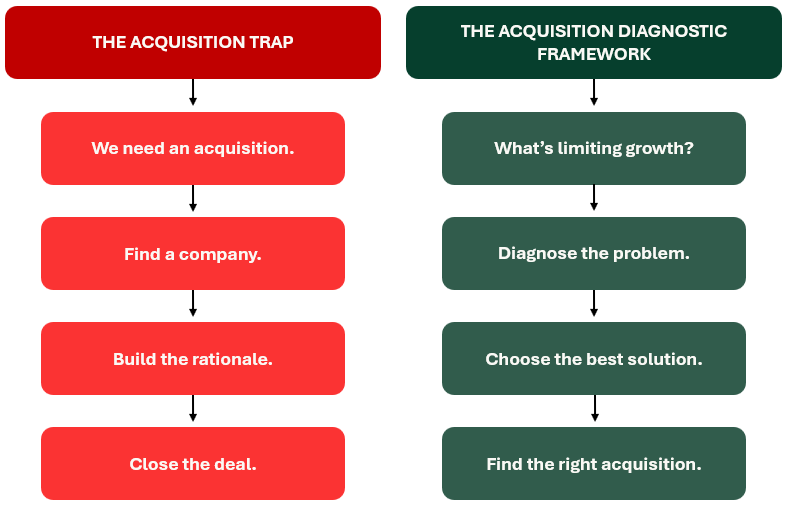
The acquisition trap happens when a company starts with the desire to acquire rather than the problem it needs to solve.
The sequence usually looks something like this:

This is how a perfectly good company can become a bad acquisition.
A manufacturer buys a competitor when its real problem is distribution. A service business buys more customers when it already can't keep up with demand. A company acquires new technology when its existing products aren't selling.
The deal may look strategic. It may even create real value. But it doesn't solve the problem that's actually capping growth.
That's the trap.
The better sequence is:

The difference may seem subtle, but it completely changes how you look for acquisitions.
You stop asking, "Is this a good company to buy?"
And start asking, "Is this the right company to solve the problem we actually have?"
Why Smart Companies Fall Into the Acquisition Trap
Companies are under pressure to grow, and acquisitions offer an appealing shortcut.
Investors want capital deployed. Boards want growth. Executives want to enter new markets, add capabilities, or make a move before a competitor does.
Then an opportunity appears.
A banker brings a deal. An owner wants to sell. A competitor becomes available. Suddenly, the conversation shifts from "What does our business actually need?" to "Should we buy this company?"
That's where the thinking can get backward.
Once a target is on the table, it's easy to find reasons to like it. New customers. New markets. Cost savings. Cross-selling. Synergies.
The question is no longer whether this is the right solution to the company's biggest growth problem. It's whether the team can build a compelling enough case for the deal.
And with enough assumptions in a spreadsheet, almost any acquisition can be made to look strategic.
The problem is that a good company can still be the wrong acquisition.
The Question to Ask before looking at a single acquisition target
Before looking at a single company, ask one question:
What is actually capping our growth?
Not what's for sale.
Not what can we afford.
Not what industry should we enter.
What is actually stopping the business from growing faster?
If you can't reach enough customers, you may need market access. If you already have the customers but aren't capturing enough of their spend, you may need a complementary product or service. If demand is strong but you can't keep up, you may need capacity, talent, or technology.
These are completely different problems. They require completely different acquisitions.
And sometimes, they don't require an acquisition at all.
That's why the order matters. First, figure out what's capping growth. Then determine what would fix it. Then decide whether to build it, buy it, partner for it, or do nothing.
Only after that should you start looking at companies.
Otherwise, you're not searching for the right solution. You're searching for a reason to justify the deal in front of you.
The Acquisition Diagnostic Framework:
Six Reasons Growth Gets Capped
Once you know what's actually capping growth, you can start looking at the type of acquisition that might fix it.
The Acquisition Diagnostic Framework™:
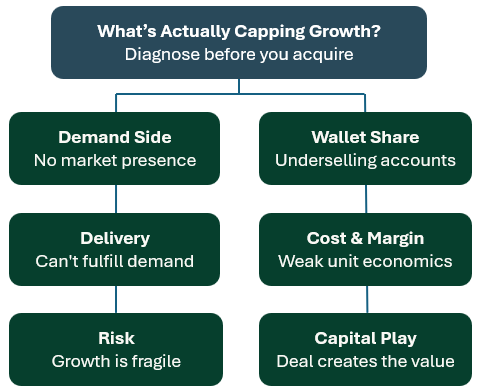
I've grouped these growth caps into six families:
- Demand-side: You can't reach the market.
- Wallet-share: You have the customers, but you're not capturing enough of their spend.
- Delivery: Demand exists, but you can't fulfill more of it.
- Cost and margin: Revenue is fine, but the economics aren't.
- Risk: The business can grow, but that growth is too exposed.
- Capital play: The deal itself creates the value.
Each one points toward a different set of acquisition types.
If your problem is market access, buying more capacity won't help. If you're already struggling to keep up with demand, buying more customers could make things worse. If margins are the problem, adding revenue may simply give you a bigger low-margin business.
The point is that you should diagnose what the business actually needs before you go shopping.
Let's look at each of the six families.
Demand Side: You Can't Reach the market
Sometimes the problem is simple: the customers you want exist, but you can't reach them.
Maybe you don't have relationships in the market. Maybe customers don't know or trust your brand. Maybe a license or certification keeps you out. Or maybe building the customer base organically would take years.
In this case, an acquisition can buy access you can't easily build.
There are four main types:
Demand Side Acquisition Types
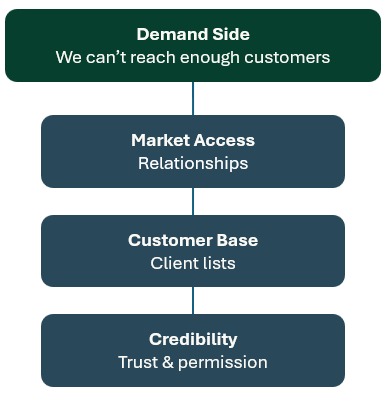
Market Access
You buy a company for its position in a market you want to enter.
The real asset isn't necessarily its technology, equipment, or even revenue. It's the relationships and access that would take you years to build yourself.
Customer Base
You buy an existing group of customers in a specific segment you want to reach.
This is different from simply buying revenue. The value is in gaining immediate access to the right customers, especially when those relationships are difficult or expensive to win organically.
Brand and Reputation
Some markets run on trust.
Customers may be reluctant to buy from an unknown company, even if its product is better. Acquiring an established brand can give you credibility that might otherwise take decades to earn.
Regulatory or Licensing Credentials
Sometimes you simply aren't allowed to compete.
Licenses, certifications, permits, contracts, or regulatory approvals can create barriers that are difficult, expensive, or impossible to overcome quickly.
In each case, the underlying problem is the same: the market exists, but you don't have an effective way into it.
That's very different from having poor sales, weak demand, or the wrong product.
And that's why the diagnosis matters. If market access is what's actually capping growth, the right acquisition isn't necessarily the biggest competitor or the company with the most revenue.
It's the one that gives you the access you need.
Wallet-Share: You Have the customer, but not enough of their spend
Sometimes you don't need more customers.
You need to sell more to the customers you already have.
You've already done the hard part. You've won the account. Built the relationship. Earned the trust. But you're only capturing a small piece of what that customer buys.
In this case, the right acquisition can help you capture more of that spend.
There are three main types:
Wallet-Share Acquisition Types
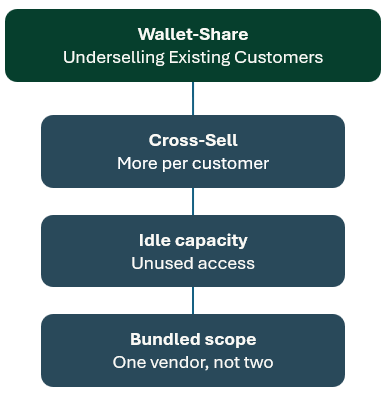
Cross-Sell
You acquire a complementary product or service that you can sell to your existing customers.
The logic is simple. You already have the relationship and the route to market. Instead of spending more money to acquire new customers, you give your current customers more reasons to buy from you.
Idle Capacity
Sometimes you're already paying for access you're not fully monetizing.
Maybe your technicians are already visiting the customer every week. Your trucks are already making the route. Your salespeople already have the relationship.
An acquisition can add products or services that use that same access, infrastructure, or customer touchpoint without requiring you to build another business from scratch.
Bundled Scope
Sometimes customers want one vendor to handle the entire job, and you're losing because you only provide part of it.
Acquiring the missing capability allows you to offer the complete scope, win larger contracts, and stop handing part of the customer's spend to someone else.
The underlying problem is the same in all three cases: you already have the customer, but you're not capturing enough of their value.
Before buying more customers, ask whether you should buy more things to sell to the customers you already have.
Delivery: You can sell it, but you can't deliver it
Sometimes demand isn't the problem. You have more work than you can handle.
The bottleneck might be people, equipment, production capacity, technology, or a capability you don't have. Whatever the cause, selling more won't fix it. You need to increase your ability to deliver.
There are three main acquisition types:
Delivery Acquisition Types
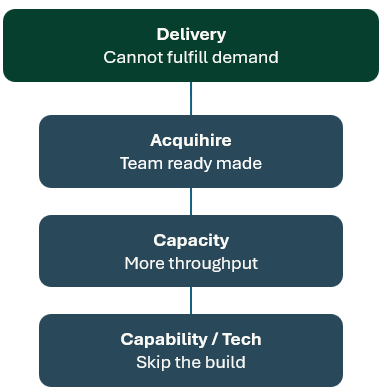
Acquihire
You buy a company primarily for its people.
This makes sense when skilled talent is difficult to find, takes years to develop, or works better as an established team than as a collection of individual hires.
Instead of recruiting one person at a time, you acquire a team that's already trained and working together.
Capacity Expansion
You buy more throughput.
That could mean equipment, facilities, crews, production lines, locations, or any other capacity needed to handle more demand.
The goal isn't necessarily to acquire more customers. It's to serve more of the demand you already have.
Capability or Technology
You buy something you can't build fast enough, or may never be able to build as well yourself.
That could be a product, technology, expertise, intellectual property, or specialized capability that would take years and significant investment to develop internally.
The underlying problem is simple: the demand exists, but you can't deliver enough of what the market wants.
When that's what's capping growth, acquiring more customers may not just be unnecessary.
It could make the problem worse.
Cost & Margin: Revenue is Fine. The economics aren't
Sometimes growth isn't the problem. The economics are.
You may have plenty of revenue, but too much of it gets eaten up by suppliers, distributors, or duplicated overhead. Selling more won't necessarily fix that. In some cases, it just makes you a bigger low-margin business.
There are three main acquisition types:
Cost and Margin Acquisition Types
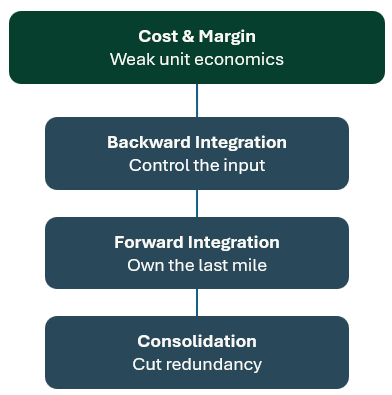
Acquisitions - Six Family Framework - Cost-and-Margin - Backward Integration - Forward Integration - Consolidation
Backward Integration
You acquire a supplier or another part of your supply chain.
This can reduce costs, improve quality, secure critical inputs, or remove dependence on a supplier that has too much power over your business.
Instead of buying from them, you own them.
Forward Integration
You acquire the distribution channel between you and the customer.
Maybe a distributor, dealer, retailer, or other middleman is capturing a significant portion of the margin. Buying that part of the value chain can give you more control over pricing, the customer relationship, and the economics of each sale.
Consolidation
You acquire another company and combine overlapping operations.
Two companies may not need two headquarters, two accounting departments, two warehouses, or two sets of administrative overhead. By combining them, the same revenue base can potentially support a much leaner cost structure.
In each case, the underlying problem is the same: the business is generating revenue, but not enough of that revenue is turning into profit.
The right acquisition helps you keep more of what you already sell.
risk: Growth exists, but it is fragile
Sometimes the business is growing just fine.
The problem is that too much of that growth depends on one customer, one market, one geography, one person, or one other point of failure.
The business can grow. But that growth is exposed.
There are four main acquisition types:
Risk acquisition types
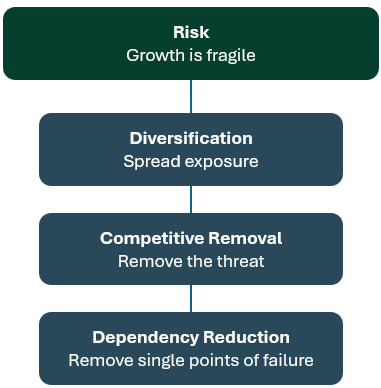
Acquisitions - Six Family Framework - Risk - Diversification - Competitive Removal - Dependency Reduction
Diversification
You acquire a business that reduces your dependence on a single customer, market, geography, or economic cycle.
If one customer represents 60% of your revenue, the next dollar of growth may be less important than reducing that exposure. The right acquisition can make the overall business more resilient.
Competitive Removal
You acquire the competitor that's putting pressure on your pricing, taking market share, or making the market less attractive for everyone.
The goal isn't just to add their revenue. It's to change the competitive dynamics of the market.
Defensive or Preemptive Acquisition
Sometimes the value of an acquisition comes from preventing someone else from buying it.
A competitor gaining access to a key technology, customer base, distribution channel, or strategic position could materially weaken your business. Buying first may protect an advantage you already have.
Key-Person Risk Removal
Some businesses depend too heavily on one founder, operator, salesperson, or technical expert.
An acquisition can help remove that dependency by bringing in additional leadership, talent, systems, or depth that makes the business less reliant on any one person.
In each case, the acquisition is more about protecting the value you've already built.
Not every good acquisition adds revenue. Some make existing revenue less fragile.
capital play: When the deal itself creates the value
Not every acquisition is about fixing something that's capping growth. Sometimes, the deal itself is the opportunity.
The value comes from buying assets cheaply, combining businesses, taking advantage of valuation differences, or acquiring something worth more than the price paid for it.
There are four main acquisition types:
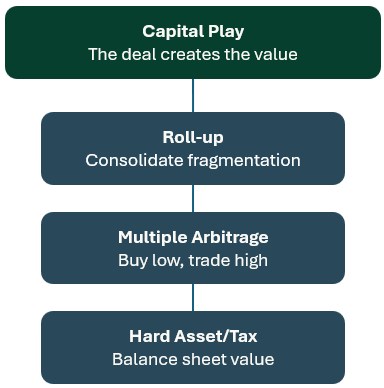
Capital Play acquisition types
Roll-Up
You acquire multiple businesses in a fragmented industry and combine them into a larger platform.
The opportunity often exists because the industry has many small operators, aging owners, limited succession plans, and no dominant player. The combined business may be more efficient, more valuable, and easier to sell than the individual companies were on their own.
Multiple Arbitrage
You buy a company at a lower valuation multiple and fold it into a larger platform that trades at a higher one.
A business acquired for four times EBITDA may become part of a platform valued at eight times EBITDA. The underlying earnings haven't changed, but what the market is willing to pay for them has.
Hard Asset Value
Sometimes the balance sheet is worth more than the business.
Real estate, equipment, permits, mineral rights, intellectual property, or other assets may be undervalued, poorly utilized, or worth more separately than they are under the current owner.
Tax Position
In some cases, an acquisition creates value through tax benefits that wouldn't otherwise be available.
The tax position isn't a side benefit. It's part of the reason the deal makes economic sense.
Capital plays are different from the other five families because the acquisition isn't necessarily solving an operating problem.
The transaction itself creates the value.
The Acquisition Diagnostic Matrix
The framework comes down to one question:
What is actually capping our growth?
The answer points you toward the type of acquisition worth considering.
The Acquisition Diagnostic Matrix
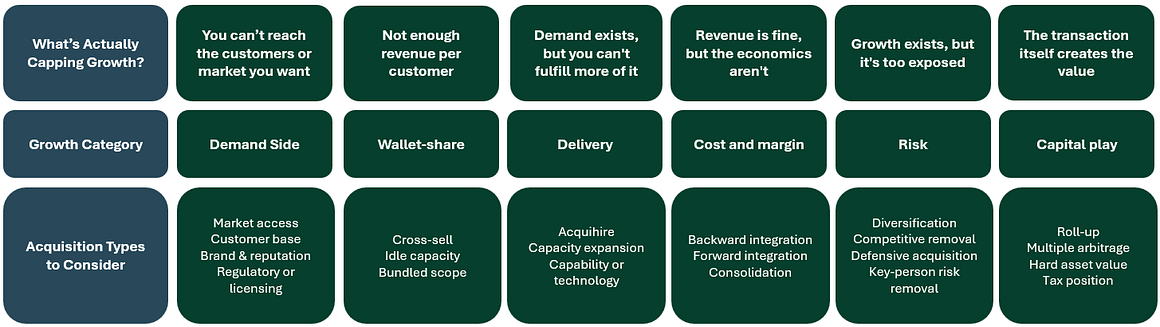
Use the matrix to identify which type of acquisition fits your growth problem. Once you've done that, start looking for companies that fit the diagnosis.
If market access is the problem, look for access. If you can't keep up with demand, look for capacity. If you're underselling existing customers, look for something more to sell them.
The acquisition should follow the diagnosis.
Not the other way around.
Before you acquire: build, buy, partner, or do nothing?
Start by identifying what's capping growth.
Once you know that, you can decide whether to build, buy, partner, or do nothing.
- Build it. Develop the capability, technology, capacity, or market access yourself.
- Buy it. Acquire a company that already has what you need.
- Partner for it. Get access through a joint venture, licensing agreement, strategic partnership, or other arrangement.
- Do nothing. Sometimes the cost and risk of solving the problem outweigh the potential upside.
The right answer depends on speed, cost, risk, control, and how difficult the asset is to recreate.
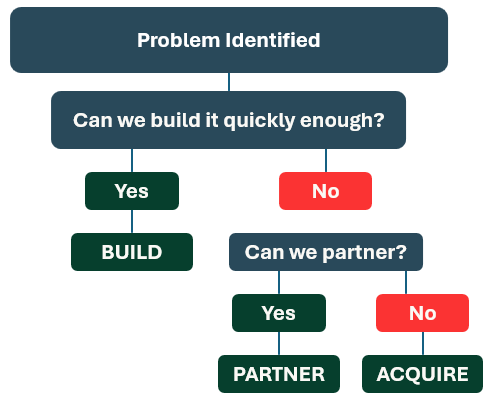
If you need a technology that would take five years to develop and a competitor already has it, buying may make sense. If you only need occasional access to a capability, a partnership may be better. If you can build what you need cheaply in six months, acquiring an entire company may be overkill.
This is where acquisition goes back to being what it should have been all along: one tool among several.
First, figure out what's capping growth.
Then decide what would fix it.
Then choose the best way to get it.
Only then should you go shopping.
Why Most M&A Frameworks Start Too Late
Most M&A frameworks help you evaluate or classify an acquisition.
Is the goal to enter a new market? Acquire technology? Add customers? Cut costs? Remove a competitor?
Those are useful questions. But they usually start after acquisition is already on the table.
The Acquisition Diagnostic Framework™ starts one step earlier.
What is actually capping our growth?
Only after answering that question do you determine what would fix the problem, whether an acquisition is the right tool, and what type of company you should look for.
That's the difference.
Use the framework before you start looking at companies, not after you've already bought one.
The structural difference is sequence.
7 questions to ask before you look at a single acquisition target
Before you start looking at companies, answer these seven questions:
1. What is actually capping our growth?
Be specific. "We need more revenue" isn't a diagnosis.
Why aren't you growing faster? Is it market access? Wallet share? Delivery capacity? Margins? Risk?
Find the real problem first.
2. What evidence proves this is the real problem?
Don't rely on assumptions.
Look at the numbers. Talk to customers. Study lost deals. Examine capacity. Follow the money.
You want evidence that solving this problem would actually unlock growth.
3. Which of the six families does it belong to?
Demand-side. Wallet-share. Delivery. Cost and margin. Risk. Or capital play.
This narrows the field and points toward the types of acquisitions that might actually help.
4. Could we solve the problem without an acquisition?
Could you build it? Hire for it? License it? Partner with someone?
Buying a company may be the answer. But it shouldn't be the default.
5. If acquisition is the right tool, what exactly do we need to buy?
Customers? Market access? Capacity? Technology? Talent? Distribution?
Define the asset you need before you start looking at companies that have it.
6. What is the smallest acquisition that would fully solve the problem?
You may not need to buy the biggest company you can afford.
You need to buy enough to remove what's holding back growth. Anything beyond that may add cost, complexity, and integration risk without adding much value.
7. What would have to be true for our diagnosis to be wrong?
This may be the most important question on the list.
Before spending millions of dollars, try to prove yourself wrong.
What if demand isn't as strong as you think? What if customers don't actually want the bundled service? What if adding capacity won't increase sales? What if the expected cross-sell never happens?
A good acquisition thesis should survive an honest attempt to kill it.
If it doesn't, you may have just saved yourself a very expensive mistake.
Conclusion: Diagnose before you acquire
Treat acquisitions like tools, not strategies.
The mistake many companies make is deciding they want to acquire, then searching for a company that looks like a good fit.
The better approach is to reverse the process.
Start by identifying what's actually capping growth. Then determine the best way to solve that problem. If an acquisition is the right answer, you'll know exactly what you're looking for, and just as importantly, what you're not.
A good company isn't necessarily the right acquisition.
The right acquisition is the one that solves the problem your business actually has.
That's the difference between buying with a strategy and buying because something happened to be for sale.