


The Brutal Truth and What to Do About It
Let’s cut through the BS.
If you're reading this, chances are you're working harder than ever… and still feeling stuck.
The numbers aren’t moving. The growth has plateaued. And deep down, you're wondering:
"What the hell am I missing?"You're not alone.
According to a study by JP Morgan Chase, only 9% of small businesses ever grow past 1 million in revenue. And of those? Most never break through their next ceiling: $3M, $5M, or $10M.
Not because they lack talent. Not because the economy is tough. Not because they need a new logo or a fancier CRM.
But because they’re solving the wrong problem.
Most founders diagnose their stagnation as a marketing issue. Or a sales issue. Or a “we just need more leads” issue.
Wrong.
The problem isn’t out there. The problem is usually inside your business, invisible, compounding, and killing your momentum from the inside out.
This Guide Is Different (And Dangerous)
You're about to step into the most practical, strategic, and brutally honest guide on the internet for answering the question:
Why isn't my business growing?
We’re going deep. I’ll walk you through:
And I’m not holding anything back.
This is built on $100M+ in sales experience, my own battle scars, and frameworks borrowed from some of the best minds in the business.
If you’ve ever felt like:
- “I’m stuck working in the business, not on it.”
- “The revenue’s decent, but the profit’s crap.”
- “I can’t seem to break through this invisible ceiling.”
Then this guide is for you.
Let’s find out exactly what’s holding you back and how to fix it.
Is It You or the Market?
“The problem well stated is a problem half solved.” - Charles Kettering
Before you throw more money at ads, sales hires, or software, let’s answer the question no one in your mastermind group will ask you directly:
"Is your growth problem internal… or external?"
Because until you diagnose the real constraint, every move is a guess. And most guesses are expensive.
That’s why I use a tool I call the Growth Diagnosis Matrix™, a dead-simple 2x2 that separates tactical issues from structural ones.
The Growth Diagnosis Matrix™
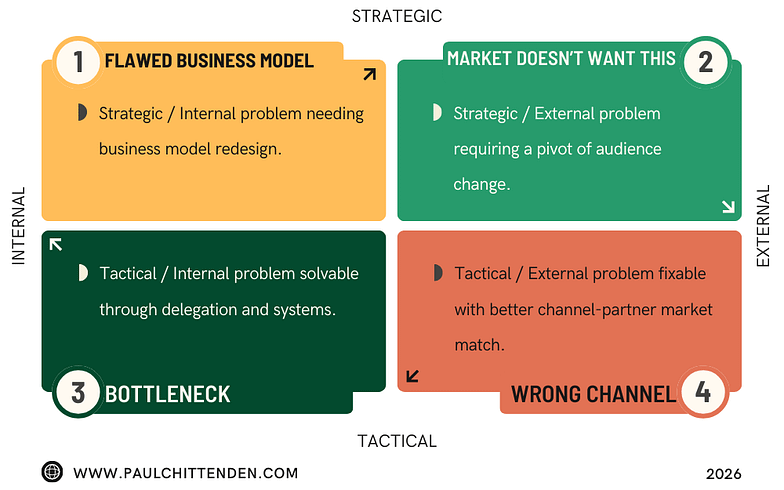
Let’s break it down.
Quadrant 1: Flawed Business Model | Strategic + Internal
Example:
You built a business that can’t scale, even if demand exploded.
- Low margins
- One-time purchases
- High customer acquisition cost
- No recurring revenue
Fix:
Business model surgery. You need to redesign your offer stack, pricing structure, and delivery system.
Quadrant 2: Market Doesn't Want This | Strategic + External
This is the danger zone.
The market doesn’t want what you’re selling.
Not at scale. Not with urgency. Not at the price you need to survive.
You don’t have a sales problem. You have a “nobody gives a damn” problem.
Fix:
Either pivot your offer or your audience or both.
Quadrant 3: Bottleneck | Tactical + Internal
Example: You’re doing everything yourself.
- Sales depend on you.
- You haven’t delegated ops.
- Every decision still flows through you.
Fix:
Systems, delegation, and removing yourself as the bottleneck.
This is the fastest quadrant to fix, and the one most owners are secretly trapped in.
Quadrant 4: Wrong Channel | Tactical + External
Example:
You're offering something valuable, but you're fishing in the wrong pond.
- Your messaging doesn’t match your market.
- You're chasing Instagram when your buyer is on LinkedIn.
- You’re relying on referrals when you need paid traffic.
Fix:
Better positioning and channel-market match.
“You don't need a better product. You need better aim.”
- Paul Chittenden, Business Growth Strategist
Action Step: Diagnose Your Business Right Now
Take 2 minutes. Grab a notepad.
Ask yourself:
- Is the problem inside the business, or outside?
- Is it tactical (execution)? or strategic (model)?
- What quadrant am I really in?
Because until you name it, you can’t fix it.
12 Silent Growth Killers Lurking Inside Your Business
These Aren't Obvious. That's Why They're Dangerous.
If your business isn’t growing, chances are it’s not because of one big mistake… It’s death by twelve papercuts.
Most of these won’t show up in your P&L. They won’t trigger alarms in your CRM.
But they will quietly bleed you dry, silently taking profit, momentum, and optionality.
Below are the most common silent killers I see in stuck 6- and 7-figure businesses.
Every one of them is fixable... Once you know where to look.
1. You’re Undercharging (And You Know It)
If your stomach drops every time a customer pushes back on price… you’re probably not charging enough.
"If you never lose deals on price, you’re not priced to grow." - Alex Hormozi
Fix:
Raise prices, then justify with value, packaging, and positioning.
A 1% price increase leads to an average 11% boost in profits (McKinsey & Co).
2. One-Time Sales, No Follow-Up
You close a customer… and never talk to them again.
No nurture. No upsell. No second transaction.
Fix:
Add a simple post-purchase email flow and one-click upsell.
Example:
A local service business added a quarterly follow-up offer and saw CLV jump 65% in 6 months.
3. No Predictable Lead Flow
You’re relying on referrals and “word of mouth.” That’s not a system. That’s a wish.
Fix:
Build a lead generation engine: SEO, paid ads, outbound, or partnerships. Pick one. Systemize it.
4. Offers That Don’t Scale
Too custom. Too manual. Too dependent on you.
Fix:
Productize the offer. Create a core service that’s 80% repeatable and 20% customizable.
“Every time you say yes to a custom job, you’re saying no to scalable growth.” - Paul Chittenden
5. No Recurring Revenue
If you have to wake up every month at zero, you're not building a business. You’re surviving.
Fix:
Turn one-time services into monthly maintenance, memberships, or retainers.
Recurring revenue businesses sell for 2x to 3x higher multiples than transactional ones (SaaS Capital).
6. No Clear USP (You Sound Like Everyone Else)
If your website or pitch could belong to your competitor… it’s not a USP.
Fix:
Sharpen your Unique Selling Proposition.
Start by answering:
“What do we do better, faster, cheaper, or different than anyone else?”
7. Founder Bottleneck
Every decision, client, and fire rolls up to you. You're the CEO and the janitor.
Fix:
Document, delegate, and delete. Hire a VA before you “need” one.
8. Website = Digital Brochure
Most websites are vanity projects.
They don’t capture leads, close sales, or drive action.
Fix:
- Add lead magnets
- Use clear CTAs
- Make your homepage convert, not just impress
“Your website should be your top-performing salesperson, not your arts-and-crafts project.” - Paul Chittenden
9. No Follow-Up System
How many leads are sitting cold in your inbox right now?
Fix:
Install a follow-up cadence: Day 1, 3, 7, 14. Use automation, but keep it personal.
80% of sales require 5+ touches. Most businesses quit after 1-2 (Marketing Donut).
10. Low Margin Offers
Top-line revenue looks sexy. But margin is what pays the mortgage.
Fix:
- Increase prices
- Cut low-margin services
- Negotiate better with suppliers
11. Selling Time, Not Value
If you’re billing by the hour, you’re anchoring your value to a clock, not your outcomes.
Fix:
Shift to value-based pricing, flat fees, or performance-based models.
12. No Data = No Clarity
You do not know your Key Performance Indicators (KPI's)
- CAC
- CLV
- Lead source ROI
- Conversion rates
You’re driving blind.
Fix: Start with these 5 metrics:
- Revenue per lead
- Lead-to-close rate
- Customer lifetime value
- Gross margin
- Net profit
“What gets measured gets managed. What doesn’t gets ignored and kills your growth silently.” - Peter Drucker
Growth Killer Self-Audit (Grab This)
Download this 12-point Growth Leak Audit Worksheet
Score your business across all 12 Growth Killers.
Plug the leaks. Then multiply what’s left.
Next up, we’ll break open the Growth Operating System™, the invisible infrastructure behind businesses that scale like clockwork.
The Growth Operating System™ (GOS)
Why Some Businesses Scale Like Machines, And Yours Feels Like a Treadmill
"Growth isn’t random. It’s engineered." - Paul Chittenden
At some point, every ambitious founder runs into the same brutal realization:
You can’t scale chaos.
If your business depends on brute force: you, your team, your hustle, it will eventually stall. Or worse, collapse under its own weight.
That’s because growth isn’t a result of effort. It’s a result of structure.
The companies that scale profitably, the ones that hit $1M, then $5M, then $20M+, all have one thing in common:
They've build a Growth Operating System™
What Is a Growth Operating System?
A Growth Operating System is the invisible infrastructure behind a scalable business.
It’s not software. It’s not a tech stack.
It’s the way your business makes decisions, captures value, and compounds momentum across every function.
Most founders don’t have one.
They run their business on gut feel and spreadsheets.
This works. Until it doesn’t.
The Growth Operating System Framework:
5 Inputs → 3 Multipliers → 1 Engine
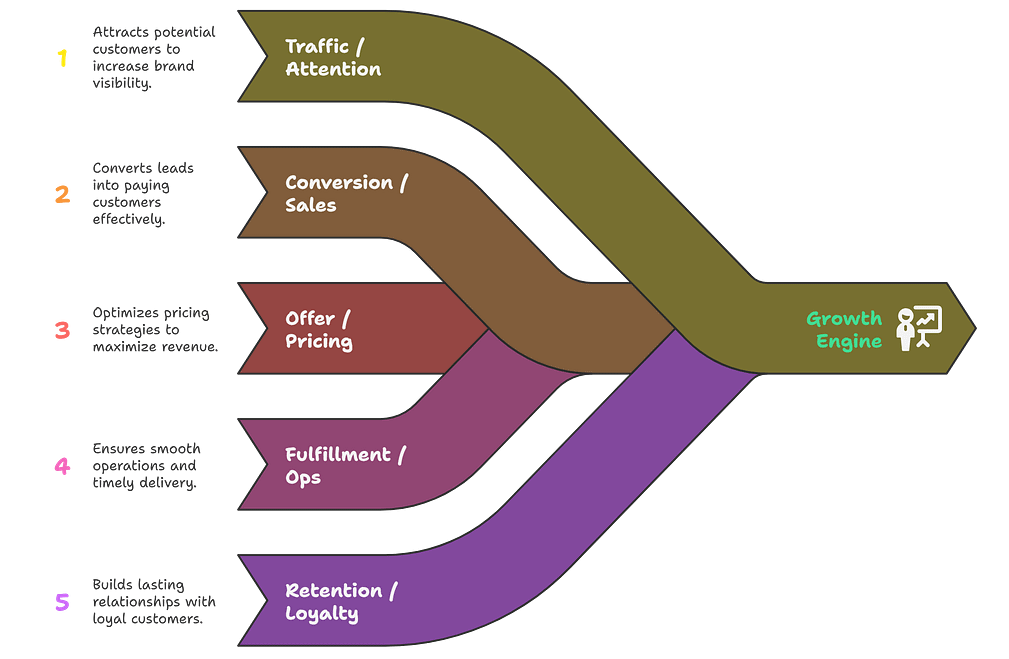
Here’s the simplified version of how a Growth OS works:
Inputs (5 Core Drivers):
- Traffic / Attention - attracts potential customer to increase brand visibility
- Conversion / Sales - converts leads into paying customers effectively
- Offer / Pricing - optimizes pricing strategies to maximize revenue
- Fulfillment / Ops - ensures smooth operations and timely delivery
- Retention / Loyalty - builds lasting relationships with loyal customers
Each of these is important, but the real power comes when they’re connected.
“People are silently begging to be led” - Jay Abraham
Multipliers (3 Compounding Levers):
- AOV (Average Order Value)
- CLV (Customer Lifetime Value)
- Margin / Efficiency
These are the math levers. Improve just one? You’ll grow.
Improve all three? You’ll multiply.
The Engine (Flywheel Logic):
When your traffic, sales, offers, ops, and retention are all dialed, and your AOV, CLV, and margins are being optimized…
You get a self-compounding growth engine.
Less hustle. More throughput.
Install the GOS in Your Business
You don’t have to build this all at once. Start with a quick Growth OS self-assessment:
Growth Operating System Input | Current Grade | Needs Work? |
|---|---|---|
Traffic / Attention | A / B / C / D / F | Yes / No |
Conversion / Sales | A / B / C / D / F | Yes / No |
Offer / Pricing | A / B / C / D / F | Yes / No |
Fulfillment / Operations | A / B / C / D / F | Yes / No |
Retention / Loyalty | A / B / C / D / F | Yes / No |
Which input is your weakest? Start there.
"You don’t need a better business. You need a better system." - Paul Chittenden
In the next section, we’ll talk mindset. Because sometimes, it’s not your system that’s broken... It’s your lens.
Are You Solving a $10 Problem with a $1 Mindset?
Your Thinking Got You Here. It Won't Get You There
One of the most common patterns I see in stuck businesses?
The founder is solving $10 problems with $1 thinking.
They obsess over the cost of new software, but ignore the fact that their offer isn’t priced for profit.
They fiddle with logos, but haven’t raised prices in 3 years.
They waste time trying to DIY everything, when one strategic hire could unlock 10x ROI.
This isn't about intelligence.
It's about mental models. And most business owners are running outdated software.
Thought Upgrade: From Tactician to Architect
Let’s draw the line clearly.
Tacticians Ask:
- “How do I get more leads this week?”
- “Should I try TikTok ads?”
- “How can I do this myself cheaper?”
- What about a billboard!?!
Architects Ask:
- “What’s our most profitable customer segment? How do we get more of them?”
- “What can we cut or automate to 2x our margin without adding headcount?”
- “How do we make $100K decisions, not $100 tasks?”
Big growth doesn’t come from doing more. It comes from thinking differently.
Example: From DIY Hustler to Strategic CEO

Web Design Agency Example
$450K/year in revenue. Founder was working 65 hours/week. No team. Stuck.
Stuck, trying to:
- Close every deal himself
- Build every site himself
- Handle client support himself
- Avoid hiring to “keep margins clean”

A needed Turning Point
“If I gave you $100K and told you to grow revenue 50% without working more, what would you do?”
Strategic Architect Thinking:
- “I’d hire a project manager.”
- “Outsource the dev work.”
- “Productize the scope.”
- “Raise prices and only take high-ticket strategy clients.”

Results from Implementation
By planning instead of firefighting, you see big results:
Result?
- Revenue grows to $720K
- Weekly hours: down to 30
- Profit margin goes up
- The founder takes a real vacation for the first time in 6 years
Same skills. New lens.
“Companies that operate from a long-term, system-based mindset outperform reactive ones by 2-5x in growth, profitability, and exit value.” - (Harvard Business Review & Bain composite data)
Reframe Your Growth Goals
Here’s a better way to think about your business:
Old Mindset | Growth OS Mindset |
|---|---|
How do I get more leads? | How do I increase revenue per customer? |
How do I cut costs? | How do I 2X margin without reducing value? |
How do I sell more? | How do I make each sale more valuable? |
How do I fix this problem? | How do I design a system that prevents this problem? |
Action Step: Run a Lens Audit
Ask yourself:
- What decisions am I making based on fear or habit?
- What part of my business am I treating like a job instead of an asset?
- Where am I playing small?
Then pick one area to stop thinking tactically and start building structurally.
Because the next level of your business? It demands a new level of you.
The Ultimate Growth Levers
AOV. CLV. Conversion Rate. Frequency. Margin.
Tiny tweaks lead to massive growth, but most business owners are playing checkers.
They chase more traffic. More followers. More leads.
All while ignoring the 5 levers that actually move the money.
If your business isn’t growing, it’s almost always because one (or more) of these five levers is broken, under-optimized, or ignored.
Here’s the cheat code:
You don't need more leads. You need more value per customer.
The 5 Core Growth Levers
These five levers form the backbone of every Growth Operating System™:
Lever | What it Means |
|---|---|
AOV | Average Order Value | How much each transaction is worth |
CLV | Customer Lifetime Value | Total value per customer over lifetime |
Conversion Rate | Percent of leads that buy |
Purchase Frequency | How often they buy again |
Profit Margin | What you actually keep after expenses |
The goal: Increase each of these by 10–20% and you get exponential revenue growth, even with the same traffic and team.
Real Math: The Compounding Effect
Let’s say you currently:
Let’s bump each lever by just 20%:
Result?
With no new traffic, your bottom-line profit grows 73%+.
Small hinges. Big doors.
Lever 1: AOV – Average Order Value
How to increase it:
- Add upsells / bundles
- Create premium tiers
- Introduce “done-for-you” options
- Use minimum order pricing
Interested in more? Here are 53 ways to increase average order value.
Example:
A pressure washing company adds a driveway sealing add-on.
It increases AOV from $290 → $415. That’s a 43% lift per job, overnight.
Lever 2: CLV – Customer Lifetime Value
How to increase it:
- Build a post-purchase nurture sequence
- Introduce subscriptions or maintenance plans
- Offer strategic add-ons over time
- Re-engage past buyers every 90 days
Interested in more? Here are 44 ways to customer lifetime value.
Stat:
Just a 5% increase in retention can boost profits by 25–95% (Harvard Business Review).
Lever 3: Conversion Rate
How to increase it:
- Add risk reversal (guarantees)
- Use testimonials and social proof
- Make your offer stupid-simple to understand
- Improve call-to-action clarity
Example:
A local gym changes their offer from “$120/month” to “21 Days for $21.”
Conversion rate tripled, and 40% upgrade to a full membership.
Lever 4: Purchase Frequency
How to increase it:
- Build continuity (subscriptions, retainer plans)
- Use seasonal offers, loyalty perks, and time-based bonuses
- Train your audience to expect regular engagement
Example:
A mobile detailing business offers a “4x per year VIP plan” instead of one-time cleanings.
CLV jumps 3x and so does scheduling predictability.
Lever 5: Profit Margin
How to increase it:
- Raise prices
- Cut low-margin offers
- Improve operational efficiency
- Renegotiate supplier terms
Example:
A supplement brand cuts two slow-moving SKUs and moved production in-house.
Gross margin: 52% → 68% in 90 days.
Download The Profit Multiplier Worksheet™
Ready to run your numbers?
Drop in your current metrics and see what happens when you tweak the dials.
This tool alone can help you find $250K+ in hidden upside without changing your team, traffic, or offer.
Tactical Fixes for the 5 Most Common Growth Bottlenecks
Find the Constraint. Fix the Machine
“Your business isn’t stuck because you’re lazy. It’s stuck because one piece of the machine is jammed.” - Paul Chittenden
When growth slows down, most owners look for fuel (more ads, more effort, more hustle).
But smart operators check the engine first.
Below are the five bottlenecks I see most often in businesses under $5M... And how to fix them without burning down what’s working.
Bottleneck #1: You're Still in the Middle of Everything
Also known as: Founder Bottleneck Syndrome
This is when you, approve every decision, jump in on delivery when things get hectic, manage every team, own sales calls, or micromanage operations. You are doing too much and not delegating enough.
Symptoms:
- Growth plateaus at the edge of your personal capacity
- You feel exhausted, not energized
- Your team’s confused or underperforming
How to Fix It:
- Hire a virtual assistant (VA) or executive assistant (EA) immediately
- Record a 3-minute Loom instead of jumping on a 30-minute call
- Write down every recurring task → delegate or delete
- Block off 2 hours a week for CEO time (strategy only)
"Freedom isn’t a goal. It’s a byproduct of systems that don’t need you." - Paul Chittenden
Bottleneck #2: Your Offer Doesn't Convert Cold Traffic
You’re great at selling to referrals… but strangers don’t bite.
Symptoms:
- Facebook ads flop
- Discovery calls ghost
- Website converts <1%
- You hear: “Sounds good… let me think about it”
How to Fix It:
- Add a risk reversal (e.g. money-back guarantee, try-before-you-buy)
- Shift from features to outcomes in your pitch
- Use a diagnostic quiz or audit tool to create pre-sale momentum
- Upgrade your headline: clear beats clever
“If your offer isn’t converting strangers, you don’t have an offer, you have a hope.” - Paul Chittenden
Bottleneck #3: No Follow-Up or Nurture Sequence
You close hot leads, but warm and cold ones vanish forever.
Symptoms:
- Low lead-to-close rate
- Pipeline constantly “dry”
- Sales team chasing ghosts
- Past clients go quiet
How to Fix It:
- Build a simple email sequence: Day 1, 3, 7, 14, 30
- Drop a voicemail + text for every proposal sent
- Schedule a 3-month check-in call with every past buyer
- Add a “win-back” campaign for lapsed customers
Stat:
80% of sales happen after the 5th follow-up, but 44% of businesses give up after the 1st (Invesp).
Bottleneck #4: You're Selling Like it's 2010
Also known as: Your sales process doesn’t match how people buy now
Symptoms:
- Long sales cycles
- Constant objections
- Price pushback
- Low close rate
How to Fix It:
- Use pre-sale content (videos, case studies, ROI calculators) to educate before the call
- Shift to permission-based selling (“Want to hear what’s working best right now?”)
- Anchor price with value, not time
- Use a 2-call close: discovery → strategy → close
Example:
Switch from cold demo scheduling to free diagnostic → strategy session.
Close rate: 18% → 42% in 60 days.
Bottleneck #5: Your Margins are too thin to reinvent the business
If you’re making $50K/month but keeping $6K… growth becomes a trap.
Symptoms:
- You feel like a cash-strapped firefighter
- Can’t hire without losing margin
- Can’t invest in growth without a panic attack
- Every new customer = more stress
How to Fix It:
- Build a simple email sequence: Day 1, 3, 7, 14, 30
- Drop a voicemail + text for every proposal sent
- Schedule a 3-month check-in call with every past buyer
- Add a “win-back” campaign for lapsed customers
Action Step: Run the Bottleneck Blitz™
Ask:
“If I had to double revenue in 90 days without working more… What one constraint would I need to fix first?”
Then fix it.
Fast.
Because growth doesn’t require more effort. It requires removing friction.
When Growth Should Slow Down
Pause ≠ Failure. Sometimes it’s the smartest power move on the board.
“Fast growth feels good. Smart growth builds wealth.” - Paul Chittenden
Sometimes… slowing down is strategic.
The business isn’t broken.
The leads are coming in. The team’s humming.
But you are fried. Margins are squeezed. And scale feels like a liability, not a win.
This is more common than most entrepreneurs admit, especially when you’re somewhere between $500K and $3M in revenue.
The “Second-Stage Stall” Is Real
According to a U.S. Chamber of Commerce study:
- 93.6% of businesses in America have fewer than 20 employees
- The vast majority of them never grow past the $1M–$3M mark
- And the #1 reason isn’t competition. It’s founder constraint
Why?
- Because Stage 1 Growth (0 to $1M) is about hustle, skill, and doing the work.
- But Stage 2 Growth ($1M to $3M+) is about team, systems, and capacity.
Most founders never make the shift.
They grow revenue but don’t upgrade the business model to handle the load.
So they hit a wall. And instead of fixing the engine, they floor the gas.
5 Signals You Should Hit the Brakes (Temporarily)
You might need to slow down if:
- Your profit margins are shrinking as you grow
- Team morale is dropping
- You haven’t taken a real vacation in over a year
- Customer experience is slipping
- You're making more revenue, but keeping less
“If scaling is breaking your ops, your margin, and your sanity, it’s not scale. It’s self-sabotage.” - Paul Chittenden
Reframe: Optimize Before You Multiply
Imagine this:
- You pause outbound for 30 days
- You audit your ops, pricing, and fulfillment
- You clean up client fit, systemize delivery, and raise prices by 20%
Now, when you hit “go” again? You’re multiplying clean profit, not chaos.
Decision Tree: Scale, Optimize, or Hold?
Ask yourself:
Question | If Yes... | If No... |
|---|---|---|
Are we profitable and operationally sound? | Scale strategically | Optimize First |
Is our team at capacity or showing burnout? | Hold and assess | Proceed with growth initiatives |
Do we have a clear, repeatable offer? | Multiply it | Refine before amplifying |
Are we turning revenue into actual cash? | Scale what works | Fix margin + cash flow |
Your next best move isn’t always speed.
Sometimes it’s precision.
Action Step: The 90-Day Optimization Sprint
If this section hit home, here’s your plan:
- Pause major growth pushes
- Identify your 2 biggest internal constraints (margin, ops, fulfillment, delivery)
- Block 90 days to fix them
- THEN restart the engine
Growth will feel easier. Cash will stack faster. Your team won’t quit.
The Growth Engine Audit™
Find the Constraint. Fix the Right Lever. Scale without Guessing.
“You don’t need more ideas. You need to fix the leak that’s stealing your growth.” - Paul Chittenden
At this point, you’ve got clarity. You’ve seen:
- Why your business might be stuck
- What’s really holding it back
- How smart companies scale without sprinting
- The levers that actually move profit
But clarity doesn’t solve the problem unless you know where to apply it.
So now it’s time to run your business through the Growth Engine Audit™.
What Is the Growth Engine Audit™?
It’s a 30-minute, self-guided diagnostic that shows you:
It’s not fluff. It’s not a quiz.
It’s the exact framework I use in consulting sessions to unlock $50K–$500K in hidden growth for business owners who feel stuck.
The 9-Point Growth Flywheel
Here’s how we audit your business. We break it into 3 Zones and 9 Levers:
Zone | Lever | What You're Assessing |
|---|---|---|
TRAFFIC & LEADS | 1. Lead Flow | Are you generating consistent, quality leads? |
TRAFFIC & LEADS | 2. Conversion Rate | Are those leads turning into paying customers? |
TRAFFIC & LEADS | 3. Offer Clarity | Do they immediately understand your value? |
VALUE & SCALE | 4. Average Order Value | Is each sale worth enough to be profitable? |
VALUE & SCALE | 5. CLV & Repeat Rate | Are customers buying again… and again? |
VALUE & SCALE | 6. Margin | Are you keeping enough of what you make? |
DELIVERY & OPERATIONS | 7. Fulfillment Bottlenecks | Are you able to scale delivery without chaos? |
DELIVERY & OPERATIONS | 8. Founder Dependence | Is growth dependent on you showing up daily? |
DELIVERY & OPERATIONS | 9. Team/Process Weakness | Can your team + systems support 2x growth today? |
You rate each on a scale of A to F, not for feelings, but facts.
Sample Output: Where Are You Leaking Growth?
Here’s an example from a client who ran this audit:
Lever | Grade | Fix Priority |
|---|---|---|
Lead Flow | B | Low |
Conversion Rate | C | Medium |
Offer Clarity | D | High |
AOV | A | Very Low |
CLV | C | Medium |
Margin | B | Low |
Fulfillment Bottlenecks | B | Low |
Founder Dependence | D | High |
Team/Process | C | Medium |
Result:
Focus on Offer Clarity, Founder Bottleneck, and Conversion.
In 6 months:
- Revenue up 28%
- Profit margin up 9 points
- Founder hours down 22/week
- No ad spend increase
Download the Free Audit Template
Download The Growth Engine Audit™
Google Sheets version
Auto-grades every lever
Tells you your #1 constraint
Suggests the 2–3 levers with highest ROI
You’ll know exactly what’s holding your business back and what to do next
“Don’t ask how to grow. Ask: which lever am I ignoring?” - Paul Chittenden
Conclusion: You're Closer than you think
The Constraint is The Key
If you made it this far, let me tell you something most people won’t:
You just need to fix the one thing that’s holding back everything else.
Maybe it’s a mispriced offer. Maybe it’s a margin leak. Maybe it’s that you’re still the bottleneck.
Whatever it is, now you know how to find it.
And more importantly, how to fix it.
Remember:
- Growth is a system, not a mystery
- Tiny changes in AOV, CLV, and margin can drive massive profit lifts
- You don’t need more leads. You need more leverage
- The real risk is staying stuck for another 6 months
And the best part?
You don’t have to do it alone.
One Ask Before You Go
If this guide helped you rethink your business, or gave you real, usable insights, send it to a friend who’s stuck.
This is how we scale smarter businesses. One sharp operator at a time.
“You don’t need to work harder. You need to think better.” - Paul Chittenden
Let’s grow something that actually lasts.
– Paul